
History of Melilla
More than 2,600 years of history in 12 km²
From Phoenician Rusadir to the autonomous city: who founded it, when it became Spanish and how it became the Melilla of today.
7th c. BC
The Phoenicians found Rusadir
1497
Spanish since 17 September
4
Fortified enclosures in Old Melilla
2nd
Spanish city with the most modernism, after Barcelona
1995
Autonomous city under its Statute
Melilla stands on a headland jutting into the Mediterranean, on the north coast of Africa. That cape — a good anchorage and easy to defend — drew Phoenicians and Romans, and later the powers of al-Andalus and the Maghreb. In 1497 it passed to the Crown of Castile, and it has been Spanish ever since.
Here is that history in order, from its founding to the present day. Dates are checked against the sources listed at the end and, where historians disagree, we say so.
7th c. BC – 5th c. AD
Rusadir, the Phoenician and Roman city
Phoenician seafarers settled on the cape more than 2,600 years ago and called it Rusadir, “the mighty” or “imposing cape”. After the decline of Carthage, the city passed to the kingdom of Mauretania and, in AD 42, to the Roman Empire.
7th c. BC
The Phoenicians found Rusadir, a trading port on the headland.
1st c. BC
The city mints coins showing bees between ears of grain, with its name in Punic letters.
AD 42
Under Emperor Claudius, Rusadir becomes part of the Roman province of Mauretania Tingitana.
429
The Vandals cross the Strait into Africa. Very little is known about the following centuries.
6th c. – 1497
Islam and the name Melilla
The period after the Vandals is poorly documented. With the Arab expansion, the city — by then called Melilla — entered the Islamic world: it was ruled from Córdoba in the 10th century and later by the dynasties of the Maghreb, always coveted for its harbour.
6th – 7th c.
Several sources place it under Byzantine rule and, around 614, Visigothic rule under King Sisebut; records from this period are scarce.
Late 7th – early 8th c.
With the Arab expansion across the Maghreb, the city enters the Islamic world.
927
Abd al-Rahman III of Córdoba takes Melilla. In the 11th century, the geographer al-Bakri describes it with a stone wall, citadel, mosque, baths and markets.
11th – 14th c.
It passes through the hands of the Almoravids, Almohads and Marinids.
Late 15th c.
The wars between the kingdoms of Fez and Tlemcen leave it in ruins and almost deserted.
1497 – 1556
1497: Melilla becomes Spanish
On the night of 17 September 1497, Pedro de Estopiñán landed at the head of an expedition organised and paid for by the Duke of Medina Sidonia, with the backing of the Catholic Monarchs. He found a city ruined by the wars between Fez and Tlemcen and took it without a fight. He left a garrison and, a year later, had to return with reinforcements to hold off attacks.
17 Sep 1497
Pedro de Estopiñán takes Melilla on behalf of the Duke of Medina Sidonia, with the support of the Catholic Monarchs.
1497 – 1556
The first fortified enclosure is built on top of the rock.
1549
The engineer Miguel de Perea builds the Gate of Santiago, crowned with the coat of arms of Charles V.
1556
Under Philip II, the dukes give up the stronghold, which was very costly to maintain, and the Crown takes over its government and defence.
17th – 18th centuries
The stronghold
For two centuries Melilla lived inside its walls and withstood several sieges. Many of the bastions, moats and tunnels you can walk through today in Old Melilla date from this period.
1680s and 1690s
Sultan Moulay Ismail takes the outer fortifications and besieges the city without forcing its surrender.
1774 – 1775
Great siege by Sultan Mohammed III, from 9 December to 19 March: an army of 30,000 to 40,000 men fails to take the stronghold, defended by Commander General Juan Sherlock.
19th century
The city spills beyond its walls
In 1859 Melilla's limits were set with an unusual formula: the territory would reach as far as a cannon could fire. The treaty that ended the Spanish–Moroccan War ratified it in 1860, and in 1862 the shot that marked the border was fired. From then on the city began to grow outside its walls.
24 Aug 1859
An agreement signed in Tetouan sets Melilla's limit at the range of a 24-pounder cannon.
26 Apr 1860
The Treaty of Wad-Ras, signed in Tetouan, ends the Spanish–Moroccan War and ratifies the agreement.
14 Jun 1862
The 24-pounder cannon “El Caminante” fires from the Victoria Grande fort to mark how far the territory reaches. The demarcation act is signed that same month.
1863
A law of 18 May declares Ceuta, Melilla and the Chafarinas Islands free ports.
1893 – 1894
Margallo War: building the Purísima Concepción fort, next to the tomb of Sidi Guariach, sparks the fighting. Governor Juan García y Margallo is killed on 28 October 1893, and General Martínez Campos negotiates peace with the sultan in Marrakesh in early 1894.
1900 – 1939
War in the Rif and a modernist city
The first decades of the 20th century brought war in the Rif, but also spectacular urban growth. New districts, the port and an explosion of modernism and art deco — led above all by the Barcelona architect Enrique Nieto — made Melilla the Spanish city with the most modernist and art deco buildings after Barcelona.
1904
Alfonso XIII lays the first stone of the port works.
27 Jul 1909
Disaster of the Barranco del Lobo, in the Melilla war. Sending reservists to that war had sparked the Tragic Week in Barcelona the day before.
1909
Enrique Nieto, who had worked on Gaudí's Casa Milà, arrives. He would design many of the city's best-known buildings, from El Telegrama del Rif (1912–1913) to the Monumental cinema (1930–1932).
22 Jul – 9 Aug 1921
Disaster of Annual. Between about 8,000 and almost 11,000 Spanish soldiers are killed or go missing, depending on the source — the Picasso Report counted 10,973 Spaniards and 2,390 indigenous troops — and Melilla is left practically defenceless.
1926 – 1927
Abd el-Krim surrenders and the war in the Protectorate ends.
17 Jul 1936
The military uprising that starts the Spanish Civil War begins in Melilla, a day before it reaches mainland Spain.
1956 – today
From 1956 to the autonomous city
With Morocco's independence in 1956, Melilla remained a Spanish city in North Africa. When Spain joined the European Community in 1986, its border became an external border of the Community — today, of the European Union — and in 1995 the city gained its Statute of Autonomy.
1956
End of the Spanish Protectorate in Morocco; many families linked to it settle in Melilla.
1969
The airport opens on 31 July.
1980
The Hindu temple opens, today part of the Route of the Temples with the Church of the Purísima Concepción, the Or Zaruah synagogue and the Central Mosque.
1986
Spain joins the European Community and Melilla's border becomes an external border of the Community (today, of the European Union).
13 Mar 1995
Organic Law 2/1995: Melilla's Statute of Autonomy makes it an autonomous city.
Where does the name come from?
Rusadir, the Phoenician name, is usually read as “mighty” or “imposing cape”, after nearby Cape Tres Forcas. The origin of “Melilla” is uncertain: one theory links it to the Tamazight tamlilt, “the white one”, after the cape's limestone; another to honey, because bees appear on the city's coins from the 1st century BC.
Arab geographers call it Malila from the 9th century, and in Riffian it is known as Mritch.
Key figures
Pedro de Estopiñán
Led the expedition that took Melilla in 1497 and left its first garrison there.
Duke of Medina Sidonia
Promoted and paid for the expedition; his house held the stronghold until 1556.
Juan Sherlock
Commander general who withstood the great siege of 1774–1775.
Juan García y Margallo
Governor killed in 1893 in the war that bears his name.
Enrique Nieto
Barcelona architect who worked on Gaudí's Casa Milà and, from 1909, gave Melilla its modernist stamp.
Melilla today
Today Melilla is an autonomous city of 86,780 people (official register, 1 January 2025) in 12.3 km², a port and a border of the European Union in North Africa. Its hallmark is the coexistence of cultures: Christians, Muslims, Jews and Hindus share streets, festivals and a mixed cuisine. The Jewish community reached some 6,000 people in 1936; today it numbers about a thousand.
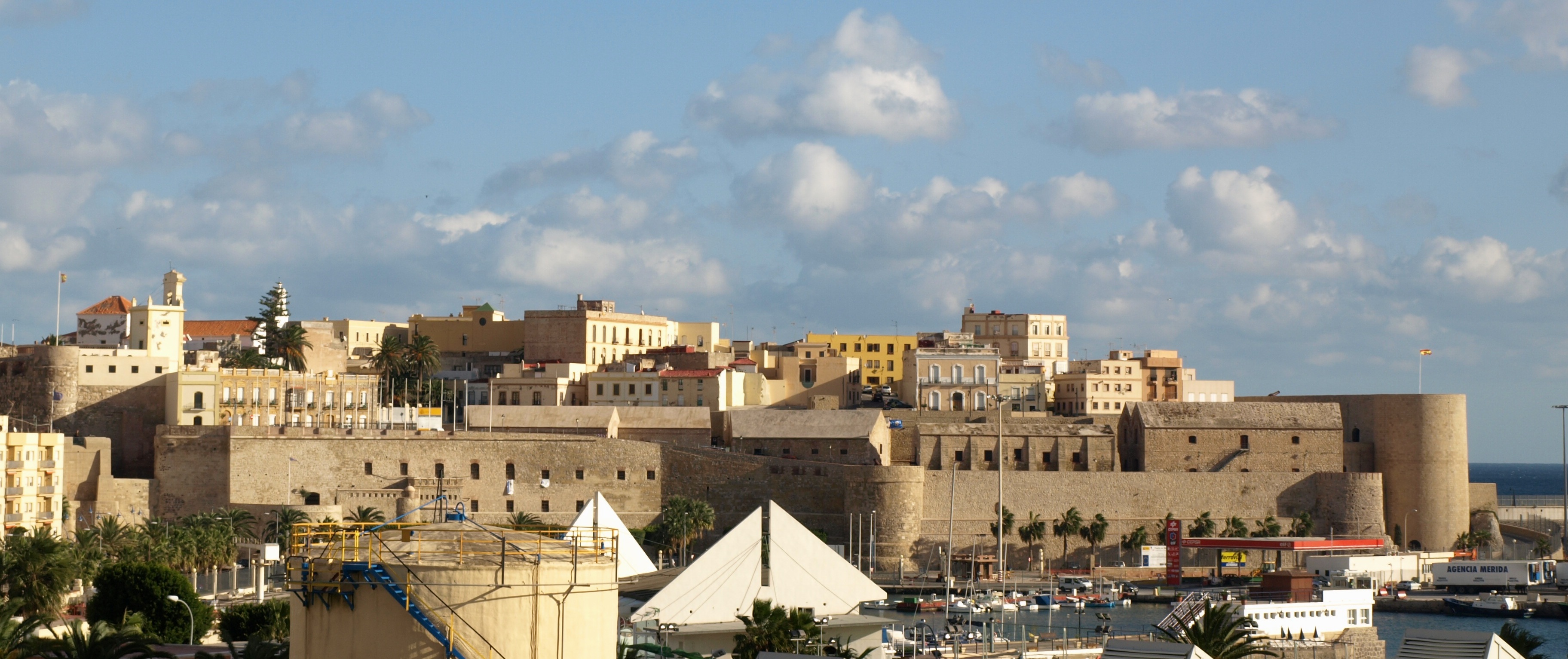
Old Melilla, a historic-artistic site since 1953, keeps four fortified enclosures built between the 16th and 19th centuries, with the Gate of Santiago, the Conventico Caves, the Church of the Purísima Concepción and the Melilla Museum. Below it, the modernist quarter can be explored on foot from Plaza de España.
See the history for yourself
The best way to understand Melilla is to walk it: the walls of Old Melilla, the museums and the modernist quarter are only a few minutes apart.
Frequently asked questions
Who founded Melilla?+
The Phoenicians, in the 7th century BC, under the name Rusadir.
Since when has it been Spanish?+
Since 17 September 1497, when Pedro de Estopiñán took it on behalf of the Duke of Medina Sidonia. In 1556 it came directly under the Crown.
Why were its limits marked with a cannon?+
The 1859 agreement with Morocco established that the territory would reach as far as a 24-pounder cannon could fire. The shot was fired on 14 June 1862 with the cannon “El Caminante”, from the Victoria Grande fort.
Did the Spanish Civil War start in Melilla?+
Yes: the military uprising began in Melilla on 17 July 1936, a day before it reached mainland Spain.
Why is there so much modernism?+
The city grew very fast in the early 20th century, just when modernism was at its height, and it had an architect like Enrique Nieto. It is the Spanish city with the most modernist and art deco buildings after Barcelona.
Since when has it been an autonomous city?+
Since its Statute of Autonomy, approved by Organic Law 2/1995 of 13 March.
Sources
Original text based on these sources. Reviewed on 18 October 2026: dates were cross-checked between them and, where they disagree, this is stated.
- Wikipedia — Historia de Melilla
- Wikipedia — Melilla
- Wikipedia (en) — Melilla
- Wikipedia — Rusadir
- Wikipedia — Melilla la Vieja
- Wikipedia — Sitio de Melilla (1774-1775)
- Wikipedia — Tratado de Wad-Ras
- Wikipedia — El Caminante
- Wikipedia — Guerra de Margallo
- Wikipedia — Desastre de Annual
- Wikipedia — Enrique Nieto y Nieto
- Wikipedia — Semana Trágica
- Wikipedia — Aeropuerto de Melilla
- BOE — Real Decreto 1117/2025 (población a 1-1-2025)
- Gaceta de Madrid (20-5-1863) — Ley de puertos francos
- Autoridad Portuaria de Melilla — El primer proyecto del puerto
- spain.info — Rutas por Melilla
- R. Castrillo — Melilla en los geógrafos árabes (UCM)
- Ruta del Modernisme — Enric Nieto i Nieto
- Archivo fotográfico UMA — Martínez Campos en Marrakech (1894)
- El Debate — Conquista de Melilla
- El Debate — La plaza de Melilla durante el asedio
- El Debate (2023) — La comunidad israelita de Melilla
- Dialnet — Los judíos de Melilla (población en 1936)
- El Faro de Melilla — El templo hindú